

 LANGUAGE

 English
  Español
Designing Sustainable Packaging: A Converter's Guide for Food and Pet Brands
When a European snack brand requalified a 250 g stand-up pouch for the German market, the artwork was never the issue. The PET / foil / PE triplex it had used for a decade carried roughly half of its weight in polyethylene, far below the 90% same-polymer threshold that European design-for-recycling guidance now applies to flexible formats. The pack performed beautifully on the shelf and could not be claimed as recyclable anywhere.
The conclusion first: designing sustainable packaging is settled at the specification stage, months before artwork is placed. Polymer family, layer count, material weight, recycled content and the end-of-life route decide whether a pouch can be marketed as recyclable, whether it still protects the product for twelve months, and which extended producer responsibility (EPR) fee band your finance team pays. Everything printed on the pack is downstream of those decisions.
Content
- 1 Six Specification Decisions That Decide Everything
- 2 The 90% Rule: What Mono-Material Really Requires
- 3 Barrier and Shelf Life: What You Give Up Going Mono
- 4 Pick the End-of-Life Route Before the Material
- 5 Format Engineering Moves More Material Than Any Resin Swap
- 6 Where Sustainable Packaging Projects Lose Money
- 7 A Practical 16-Week Plan for Switching a Structure
- 8 Frequently Asked Questions
- 8.1 Q1. What is sustainable packaging design?
- 8.2 Q2. How much of a pouch must be one material to be recyclable?
- 8.3 Q3. Are biodegradable pouches better than recyclable ones?
- 8.4 Q4. Does sustainable packaging cost more?
- 8.5 Q5. Which certifications should I check with a packaging supplier?
- 8.6 Q6. What is the PPWR and does it affect my packaging?
Six Specification Decisions That Decide Everything
In flexible packaging, sustainability is not a marketing exercise, it is a drafting exercise. Six choices carry almost all of the environmental and commercial weight, and each one has a production consequence that shows up on the filling line rather than in a slide deck.
| Design decision | What it changes on the line | Typical trade-off |
|---|---|---|
| Mono-material simplification (all-PE or all-PP) | Film structure, seal window, line speed | Lower oxygen barrier; EVOH tie layer or MDO-PE may be needed |
| Gauge reduction of 10-20% | Web tension, seal pressure, drop performance | Requires new seal validation and shelf-life retest |
| Post-consumer recycled content (PCR) | Resin sourcing, food-contact compliance route | Availability, colour and odour limits in food contact |
| Certified compostable substitution | Converting, storage humidity, sealing | Recovers value only where industrial composting collection exists |
| Fiber-based or paper formats | Filling equipment, moisture protection | Usually needs a coating or liner for long shelf life |
| Right-sizing, or a format change | Fill weight accuracy, pallet cube, case count | New filling tooling may be required |
Change one of these and you can usually manage the risk with a pilot run. Change three at once without film trials and shelf-life data, and you are buying a recall rather than a sustainability story.
The 90% Rule: What Mono-Material Really Requires
Most European guidance for polyolefin flexible packaging, CEFLEX and RecyClass among them, converges on one number: at least 90% of the pack's weight should be a single polymer, normally PE or PP. That budget has to cover the sealant, the outer web, the adhesive, the barrier layer, the zipper and the ink. Nothing is free, and a zipper or spout in the wrong polymer can consume the allowance on its own.
A mono-material structure is not "PE only". It is PE plus a small, deliberate allowance for EVOH, tie layers or a thin metallised layer. Stay inside the allowance and the pack sits in the recyclable design band; exceed it and the pack drops into a higher EPR fee class in several EU markets.
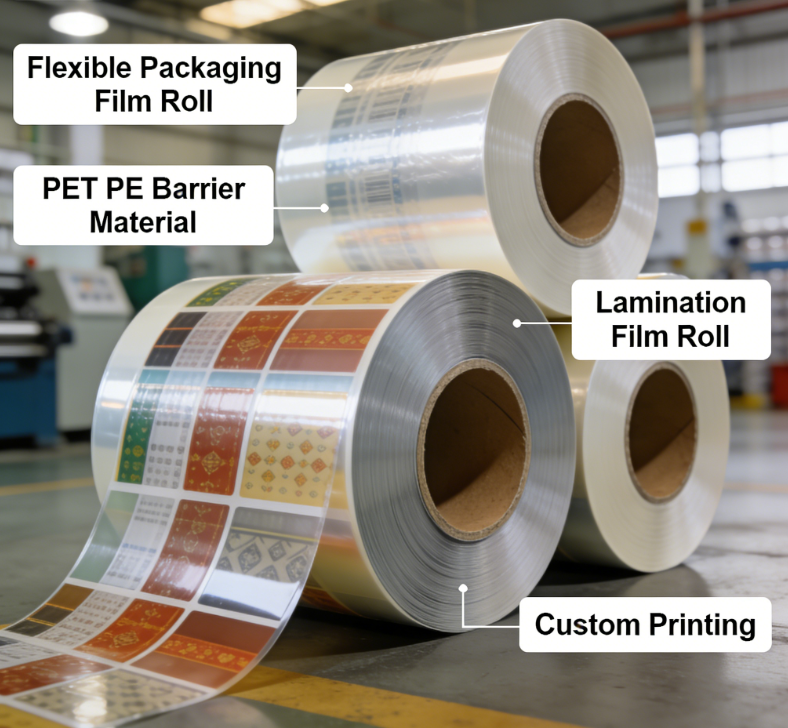
Rollstock is normally where the redesign is proved first, because a simple structural swap can be trialled on an existing filling line before any pouch tooling is commissioned. High-barrier cast composite film and food-grade BOPP rollstock are the usual starting point: they let you test seal windows, gas transmission and print registration on small volumes before a full pouch conversion. We describe the comparison method in more detail in our guide to eco-friendly food packaging materials and supplier selection.
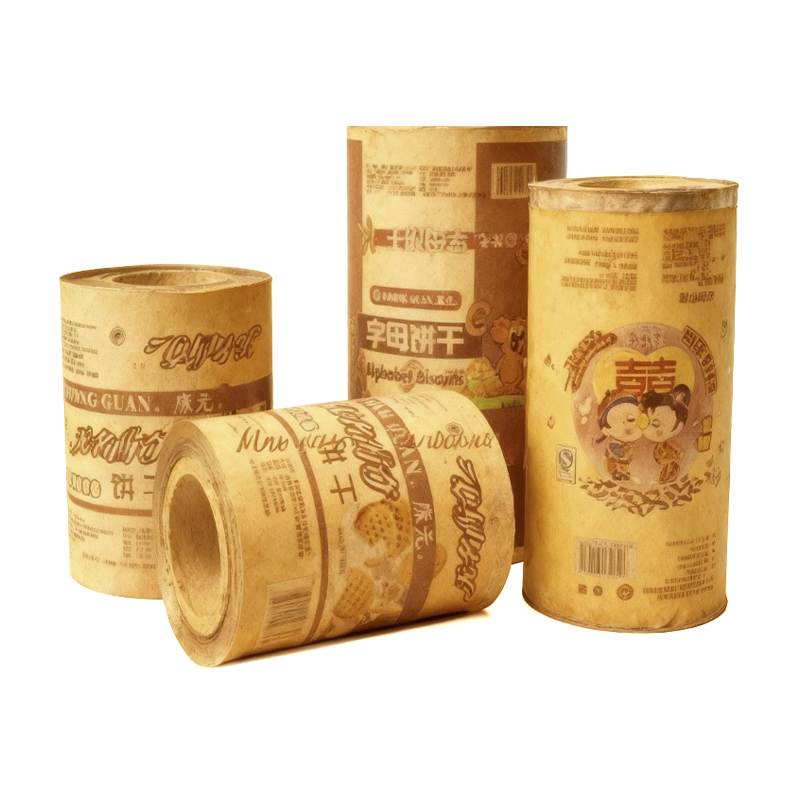 Rollstock Film ManufacturerOur roll film precisely addresses five core concerns of purchasers: **compatibility, material compliance, barrier protection, print quality, and customizable control**...View Product →
Pick the End-of-Life Route Before the Material
Recyclable, compostable and fiber-based are three different projects with three different audiences. Choosing the route first usually removes half of the material shortlist immediately, and it prevents the most common mistake in this category: buying a compostable film for a market that has no industrial composting collection.
Recyclable (mechanical)
Requires a mono-material structure and a collection stream that actually accepts flexible formats. Where kerbside collection for films is not yet available, store drop-off schemes and mono-PET or mono-PP lids for cups can still keep an entire pack in one polymer stream and out of a mixed-material fee band.
Compostable
EN 13432 and ASTM D6400 certify industrial composting, not home composting and not litter degradation. Film gauge, barrier content and even the ink system are constrained, so compostable pouches usually suit shorter shelf lives, dry or low-fat contents and closed-loop venues such as events, stadiums and food service. Compostable stand-up pouch formats are now practical for these applications.
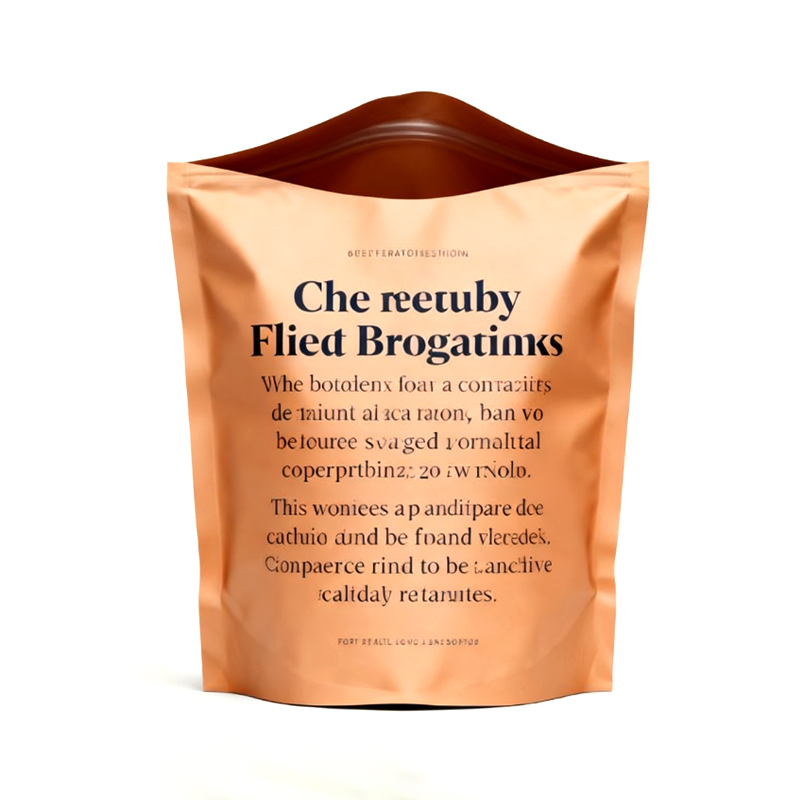 Stand Up Pouch: Biodegradable Stand Up PouchThe mainstream styles are ordinary stand-up pouches (with accordion pleats at the bottom) and octagonal stand-up pouches (with an eight-sided three-dimensional design)...View Product →
Fiber-based
Paper carries a strong consumer signal and a real recycling stream in most markets, but it is not a barrier. Bags and board formats need a coating, a liner or an inner pouch for anything moist or fat-containing, and the fiber should come with chain-of-custody documentation such as FSC. Where moisture resistance is not critical, paper remains the simplest switch a brand can make.
Format Engineering Moves More Material Than Any Resin Swap
Before renegotiating a film structure, look at the format. A stand-up pouch uses far less material per gram of product than a rigid pack, and a flat-bottom pouch improves pallet cube and shelf stability for larger fills. A spout pouch replacing a rigid bottle is commonly cited in industry comparisons as cutting plastic use per litre by 60-80%, largely because the pack is a film rather than a moulded container.
Two smaller decisions also move the needle:
- Lid film in mono-PET or mono-PP matched to the cup, so the whole pack stays in one polymer stream instead of separating into aluminium and plastic.
- Refill and reuse formats, which cut material per use even when the film itself is not recyclable, as long as the refill pack is right-sized to the dispenser.
Fiber formats deserve their own place in the same conversation. Paper bags and board carriers are the lowest-risk entry point for retail, gift and takeaway applications where barrier is not the limiting factor.
 Paper Packaging ManufacturersFlexible Packaging Food Packaging Pouches Food Packaging Pouch BagsView Product →
Where Sustainable Packaging Projects Lose Money
Most failures we see are procedural, not technical. These five gaps account for the majority of them.
- Claims without documents. "Eco", "biodegradable" and "recyclable" need test reports, certificates or design-guideline evidence behind them. Ask for the EN 13432 or ASTM D6400 report, the recycled-content declaration, or the design assessment, not a brochure.
- Downgauging without retest. Removing 15% of film weight changes drop performance and seal strength. Without a fresh shelf-life and distribution test, the saving is theoretical.
- Migration risk with recycled resin. Food-contact compliance for PCR depends on the resin's source and the functional barrier in the structure. This is a specification question, not a purchasing shortcut.
- Certification gaps at the converter. ISO 9001, ISO 14001 and BRCGS status, plus current audit dates, tell you whether the supplier can hold a claim through production. It is worth understanding how a plant is set up before you commit tooling; our manufacturing and quality setup page shows the kind of detail to request from any supplier.
- Missing EPR data. Fee modulation is calculated from pack weight by component and material. Brands that cannot report film weight separated from the zipper, spout or label pay more than they should.
A Practical 16-Week Plan for Switching a Structure
Timelines slip when trials are sequenced in the wrong order. This is the sequence that keeps a structure change inside a single quarter.
- Weeks 1-2: define the end-of-life route, target shelf life, fill weight and the EPR market, then shortlist two or three structures.
- Weeks 3-5: run film trials on rollstock and confirm seal window, registration and line speed.
- Weeks 6-9: real-time shelf life, seal strength and drop testing, including a humidity condition that matches the worst-case market.
- Weeks 10-11: freeze artwork, confirm print method, and collect the certification and recycled-content paperwork.
- Weeks 12-14: pilot run, filling line trial, case packing and pallet stability check.
- Weeks 15-16: production rollout, plus component-level weight data handed to the EPR reporting team.
Frequently Asked Questions
Q1. What is sustainable packaging design?
It is the practice of deciding material, weight, recycled content and end-of-life route together with shelf life and unit cost, so the pack can be recovered where it is sold. In flexible packaging that usually means mono-material structures, lighter gauges and a verified recovery route.
Q2. How much of a pouch must be one material to be recyclable?
Most polyolefin design guidance, including CEFLEX and RecyClass, asks for at least 90% by weight of a single polymer, with limited barrier, adhesive and additive content, and compatible closures.
Q3. Are biodegradable pouches better than recyclable ones?
Not automatically. Certified compostable film creates value only where industrial composting collection exists. In most markets, a mono-material recyclable pouch reduces more impact than a compostable one that ends up in general waste.
Q4. Does sustainable packaging cost more?
Film usually costs slightly more per kilogram, but mono-material downgauging, format changes and correct EPR reporting often offset it. The larger hidden cost is testing time, which is why a 16-week plan matters.
Q5. Which certifications should I check with a packaging supplier?
Look for ISO 9001 and ISO 14001 for quality and environmental management, BRCGS for food-contact production, FSC for paper, EN 13432 or ASTM D6400 test reports for compostables, and a recycled-content declaration for PCR claims.
Q6. What is the PPWR and does it affect my packaging?
The EU Packaging and Packaging Waste Regulation (Regulation (EU) 2025/40) has applied since 12 August 2026. It sets recyclability and recycled-content requirements for packaging placed on the EU market, so structure decisions now carry a compliance deadline.
Sustainable packaging design rewards brands that treat it as an engineering project rather than a communications one. Fix the structure, prove it with recognised test methods, document the claims, and the marketing line writes itself. Zhiwei Packaging has been converting flexible packaging in Longgang, the printing hub near Shanghai and Ningbo ports, since 1989, and holds ISO 9001, ISO 14001 and BRC certification across pouch, rollstock, spout and paper formats for food, pet food, beverage and retail customers.