

 LANGUAGE

 English
  Español
Sustainability Credentials in Coffee Bag Packaging: What Buyers Should Verify
A specialty coffee roaster in the Pacific Northwest receives a request for proposal from a regional grocery chain. Three pages in, the buyer asks a pointed question: "Please document the sustainability credentials of your coffee bag packaging." This is no longer a request reserved for large CPG companies. Retailers, importers, and foodservice distributors now treat verifiable packaging claims as a condition for listing a coffee product, and the answer has to be more specific than a green logo printed on the front of the bag.
The strongest sustainability credentials in coffee bag packaging sit on three layers: recognised certifications, materials with a clear end-of-life pathway, and a supplier whose own operations are documented and audited. A roaster that can show all three can answer a buyer's due-diligence questionnaire in one page. The other benefit is defensive: clear credentials lower the risk that a claim could later be called out as greenwashing.
Content
- 1 What counts as a sustainability credential on a coffee bag?
- 2 Certification marks buyers recognise
- 3 Material-level credentials: what each structure really delivers
- 4 Structural design is a sustainability credential too
- 5 How to audit a packaging supplier's claims
- 6 Cost, procurement risk, and how to balance the trade-offs
- 7 FAQ: sustainability credentials for coffee bags
- 7.1 Are coffee bags recyclable?
- 7.2 What does a compostable coffee bag mean?
- 7.3 Which sustainability certifications matter most for coffee packaging?
- 7.4 Do compostable bags keep coffee as fresh as foil bags?
- 7.5 Can I put a degassing valve on a compostable coffee bag?
- 7.6 How much do sustainable coffee bags cost?
What counts as a sustainability credential on a coffee bag?
A credential is a claim that can be verified through a standard, a certificate, or a tested material property. It is not the same as a marketing phrase. A label that says "eco-friendly" proves nothing; a label that says "biodegradable" means little unless a certification scheme defines the conditions. Buyers in coffee are trained to look for the proof behind the word, which is why the structure below has become a common template in sourcing documents.
| Layer | Examples | How it is verified |
|---|---|---|
| Certification marks | FSC, BPI, OK Compost, Seedling | Certificate issued by an accredited body |
| Material claims | PCR content, mono-material PE, compostable film | Test reports and product data sheets |
| Structural features | Degassing valve, zipper, lightweighting | Design review and specification control |
| Manufacturer credentials | ISO 14001, BRC | Documented audits of the supplier's site |
The table separates design intentions from evidence. A coffee bag can carry a beautiful forest illustration and still fail every environmental test. Conversely, a plain bag with a small FSC logo and a compostability mark will usually outperform a decorated one in a formal procurement review.
Certification marks buyers recognise
When a buyer asks for a sustainability credential, the fastest proof is a certification mark printed on the bag and backed by an accredited body. For paper-based coffee bags, FSC chain-of-custody is the mark most retail buyers recognise because it documents the origin of the paper fibre. For compostable bags, the names to know are BPI in North America and TUV Austria's OK Compost or the EU Seedling programme in Europe. These schemes require physical testing against ASTM D6400 or EN 13432, and both standards set 180 days as the maximum time for industrial composting.
Recyclability is a different kind of credential because it depends on local collection systems. The EU's Packaging and Packaging Waste Regulation is pushing recyclability claims toward design-for-recycling data, so a bag sold in one country should be checked against that country's sorting reality. In North America, a mono-material PE structure is recyclable only where film drop-off programmes exist. The label wording should therefore be precise: "check local programmes" is more defensible than "100% recyclable."
The manufacturer's own system matters too. We hold third-party certifications such as ISO 9001, ISO 14001, and BRC, and buyers increasingly ask packaging suppliers for these documents before requesting a quote. They indicate that quality and environmental responsibility are managed systematically rather than improvised per order.
Material-level credentials: what each structure really delivers
Material credentials describe what the bag is made of and what happens to it after use. Coffee is a demanding product: oxygen destroys aroma, and fresh-roasted coffee releases CO2 for days after roasting. A sustainable material that cannot protect the coffee will simply create waste earlier in the chain. For that reason, every option below is evaluated on barrier first, then on end-of-life.
Certified compostable structures
Compostable coffee bags are typically made from PLA-based or cellulose-based films, often combined with paper. They are tested to disintegrate within 180 days in an industrial composting facility, and home-compostable versions carry a stricter label such as OK Compost HOME. The trade-off is that no compostable film matches foil-laminated PE on long-term oxygen barrier, so roasters should expect a shorter recommended shelf life. For roasters that want a ready-made format, manufacturers now offer biodegradable stand-up coffee pouches produced from certified compostable films and bio-based inks.
 Stand Up Pouch: Biodegradable Stand Up Pouch Supplier & ODM Factory - Hangzhou ZHangzhou Zhiwei Packaging Technology Co., Ltd is a China Stand Up Pouch: Biodegradable Stand Up Pouch Supplier & Factory, we provide OEM ...View Product →
Recyclable mono-material PE
Mono-material polyethylene is the strongest competitor to foil because it keeps a high barrier and can be recycled in PE film streams. The barrier usually comes from a thin EVOH layer, and the structure stays recyclable when the EVOH share stays below the threshold accepted by recycling sorters, often around five percent by weight. For roasters that bag on their own lines, high-barrier composite rollstock film from a single supplier keeps the structure simple while preserving the oxygen and moisture protection coffee needs. Post-consumer recycled content can be blended into the film, and the PCR percentage must be stated precisely on the specification sheet.
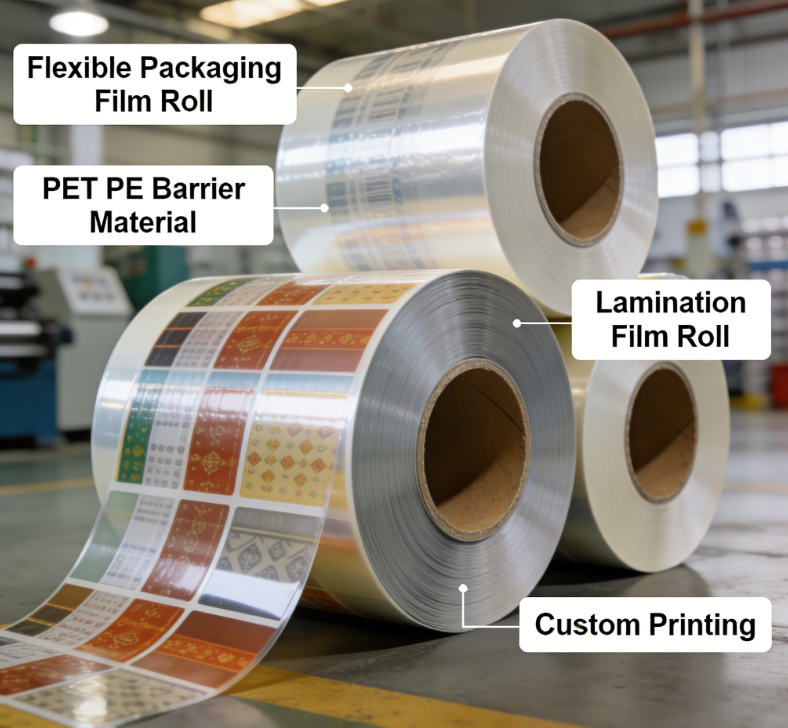 BOPP Lamination Film Roll ManufacturerProfessional factory supply food grade BOPP lamination film roll with custom printing. PET PE composite high barrier waterproof film for ...View Product →
Paper-based with bio-based lining
Paper bags with bio-based coatings have strong shelf appeal and a credible renewable story, but they offer lower barrier performance. They work best for short-turnaround coffee sold quickly through cafes, or as the outer layer of a bag that contains an inner recyclable liner.
Structural design is a sustainability credential too
A bag that keeps coffee drinkable until the last gram is a sustainability solution, not just a package. The biggest environmental impact of coffee is not the packaging; it is the coffee that gets thrown away because it went stale. That is why the degassing valve matters. Fresh-roasted coffee releases CO2, and without a one-way valve the bag will balloon or the coffee will sit under too much oxygen. Many roasters choose custom one-way degassing valve bags so that the valve position, film type, and certification of the whole assembly are controlled by one supplier.
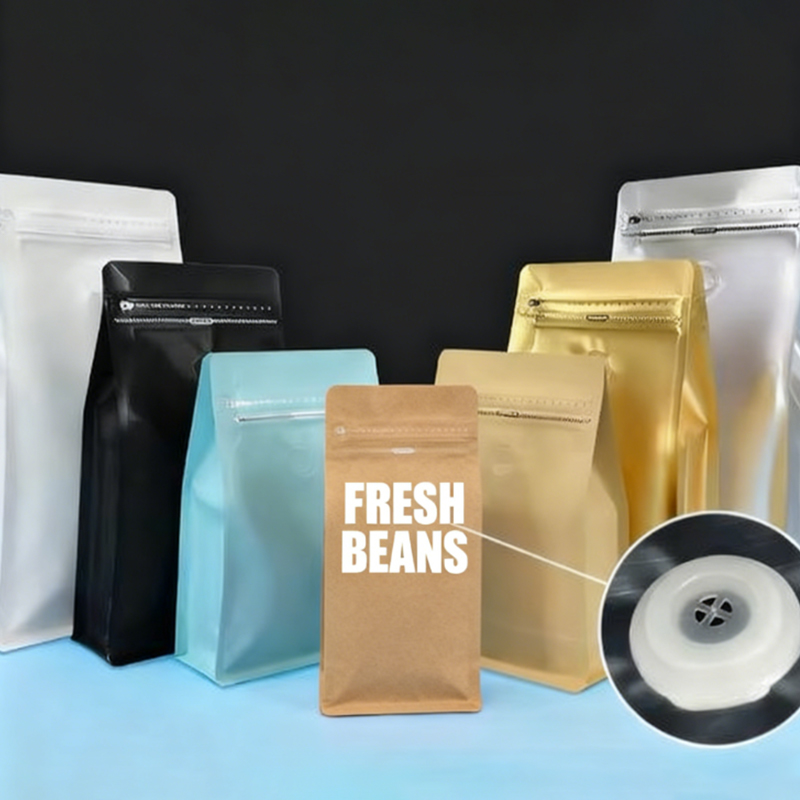 Vacuum Air Valve Bag Supplier & ODM Factory - Hangzhou Zhiwei Packaging TechnoloHangzhou Zhiwei Packaging Technology Co., Ltd is a China Vacuum Air Valve Bag Supplier & Factory, we provide OEM & ODM design, printing a...View Product →
A resealable zipper is the second structural credential. It lets consumers close the bag properly, slowing staling after opening and reducing food waste in homes. The third structural factor is dimensional efficiency: a bag that is larger than needed adds cardboard, air, and transport emissions. Right-sizing the pouch and the outer shipper reduces both cost and environmental load without changing the product inside.
How to audit a packaging supplier's claims
Greenwashing is now a commercial risk for the brand, not just the supplier. In the EU, the Unfair Commercial Practices Directive targets vague environmental claims; in the US, the FTC Green Guides do the same. A buyer who finds a "sustainably packaged" claim without substantiation can reject the product, and regulators in several markets can fine the brand that printed the claim. Because the brand owns the label, the brand has to own the evidence.
Practical checks to run before approving a coffee bag structure:
- Ask for the certificate in the supplier's name, with the exact product name and validity date.
- Ask for accredited test reports, such as those from ISO/IEC 17025 labs, not a one-page marketing sheet.
- Clarify where the bag is certified to compost: industrial facility, home compost, or both.
- Check the supplier's own environmental management system, such as ISO 14001, and its factory audit record.
- Confirm the label wording with the supplier: "recyclable", "compostable", and "recycled content" each have strict conditions.
Suppliers that have invested in environmental systems give clearer answers. We have documented how we build eco-friendly flexible packaging into our standard product range and kept the relevant quality, environmental, and food-safety certificates available for buyers to inspect.
Cost, procurement risk, and how to balance the trade-offs
Sustainable coffee bags cost more per unit. Compostable films carry a premium over conventional PE, and certified paper costs more than uncoated paper. PCR content adds another cost line, especially when recycled resin prices are high. The practical approach is to compare structures on the same specification: the same dimensions, the same valve, the same zipper, the same print coverage. Only then does the price difference reflect the material, not the quote.
Total cost should also include the end-of-life side. In the EU, extended producer responsibility fees are calculated partly on recyclability, so a certified recyclable structure can lower those fees. And stale coffee that consumers throw away is a cost to the brand: the bag's freshness performance belongs in the calculation. The radar chart below illustrates how the three structures are weighed in procurement decisions; it is a qualitative view, not a laboratory result.
FAQ: sustainability credentials for coffee bags
Are coffee bags recyclable?
Only mono-material structures such as PE coffee bags with a thin EVOH barrier are designed to be recyclable in PE film collection streams. Multilayer foil bags are generally not recyclable. Check the resin code and your local film drop-off rules before printing a recyclable claim.
What does a compostable coffee bag mean?
A certified compostable coffee bag passed ASTM D6400 or EN 13432 and must disintegrate within 180 days in an industrial composting facility. It is not designed for a backyard pile unless it also carries a home-compost label such as OK Compost HOME.
Which sustainability certifications matter most for coffee packaging?
For compostability, BPI and TUV OK Compost are the most recognised marks. For paper, FSC chain-of-custody is standard. For the manufacturer, ISO 14001 and BRC provide the baseline evidence that environmental and food-safety systems are audited.
Do compostable bags keep coffee as fresh as foil bags?
Modern compostable structures provide good but not identical barrier performance to foil-laminated bags. A compostable bag with a one-way degassing valve can protect freshness for several months, but roasters usually set a shorter best-before window and should validate shelf life with a storage test.
Can I put a degassing valve on a compostable coffee bag?
Yes. Compostable valves are available, and the whole assembly, including film, zipper, valve, and ink, should be certified as one structure. Ask the supplier for the certificate that lists the finished bag, not just the film.
How much do sustainable coffee bags cost?
Industry cost comparisons typically put certified compostable structures at a premium over conventional PE and foil laminates, with the gap depending on volume, certification, and resin prices. Request quotes for identical bag specifications to see the real difference.