

 LANGUAGE

 English
 Español

Eco-Friendly Packaging: Material Trade-Offs, Certifications and Sourcing Costs
Three quotes land on a coffee buyer's desk on the same afternoon: a compostable stand-up pouch, a mono-material pouch with 30% recycled content, and a kraft-paper laminate. All three arrive labelled eco-friendly packaging. The prices sit in three different brackets, only one carries a valid industrial-compostability certificate, and only one can actually enter the kerbside recycling stream most of that brand's customers have access to.
The short answer is that eco-friendly packaging is not a material you pick off a catalogue page. It is a set of trade-offs between barrier performance, end-of-life infrastructure, certification scope and landed cost. Get the trade-off wrong and you end up paying a premium for a pouch that behaves worse on the filling line and cannot be recycled where it is sold.
The rest of this guide works through those trade-offs in the order a packaging buyer usually meets them: what has to be proven, how structures compare, where the real carbon savings sit, and which questions separate a capable converter from a brochure.
Content
- 1 What "eco-friendly" actually has to prove
- 2 Flexible packaging materials compared
- 3 Where the real carbon reduction sits
- 4 Reading a mono-material structure
- 5 Certifications buyers should verify, not just collect
- 6 Matching the pouch format to the product
- 7 Evaluating the converter, not just the sample
- 8 Frequently asked questions
What "eco-friendly" actually has to prove
Environmental claims in flexible packaging are only meaningful when they are tied to a verifiable route. Four dimensions carry most of the weight in a supplier conversation:
- Source reduction. Removing 5 to 10 microns of structure often delivers a larger carbon reduction than swapping to a bio-based resin, because material mass falls across every unit shipped.
- Recycled content. Post-consumer recycled (PCR) resin displaces virgin feedstock. According to EcoEnclose's sustainable packaging framework, recycled inputs can cut carbon emissions by roughly 70–90% compared with virgin material, depending on the polymer and the grid mix.
- Design for recyclability. Mono-material PE or PP structures fit existing #2 and #5 streams far better than multi-layer laminates containing aluminium foil, metallised PET and mixed adhesives.
- Compostability and reuse. These are legitimate routes, but only where collection or industrial composting infrastructure exists. A certificate does not create a collection bin.
The practical consequence: for most food, beverage and pet-food brands, a mono-material structure with recycled content is the lower-risk route. A compostable pouch is the right answer only when the brand controls disposal — closed venues, events, or a take-back programme.
Flexible packaging materials compared
No row in the table below is universally "best". Each option solves a different constraint, and the cost index shifts with order volume, print complexity and the number of conversion steps.
| Structure | Barrier | End-of-life route | Typical use | Cost index |
|---|---|---|---|---|
| Mono-material PE or PP | Moderate | Recyclable where #2/#5 streams exist | Frozen food, dry goods, refill packs | 100–110 |
| Recycled PE or rPET laminate | Moderate | Partly recyclable; depends on adhesive | Coffee, snacks, personal care | 105–125 |
| Paper-based laminate | Low to moderate | Requires separation; rarely recycled | Dry food, tea, retail bags | 110–135 |
| PLA or other bio-based film | Low to moderate | Industrial compost only | Short-shelf-life produce, events | 130–180 |
| PBAT/PLA blend | Moderate | Industrial compost only | Agricultural film, carry bags | 140–200 |
One pattern is consistent across converters: the jump from conventional laminate to a mono-material recyclable structure is usually smaller than the jump from mono-material to a certified compostable one. That gap is where most sourcing budgets get surprised.
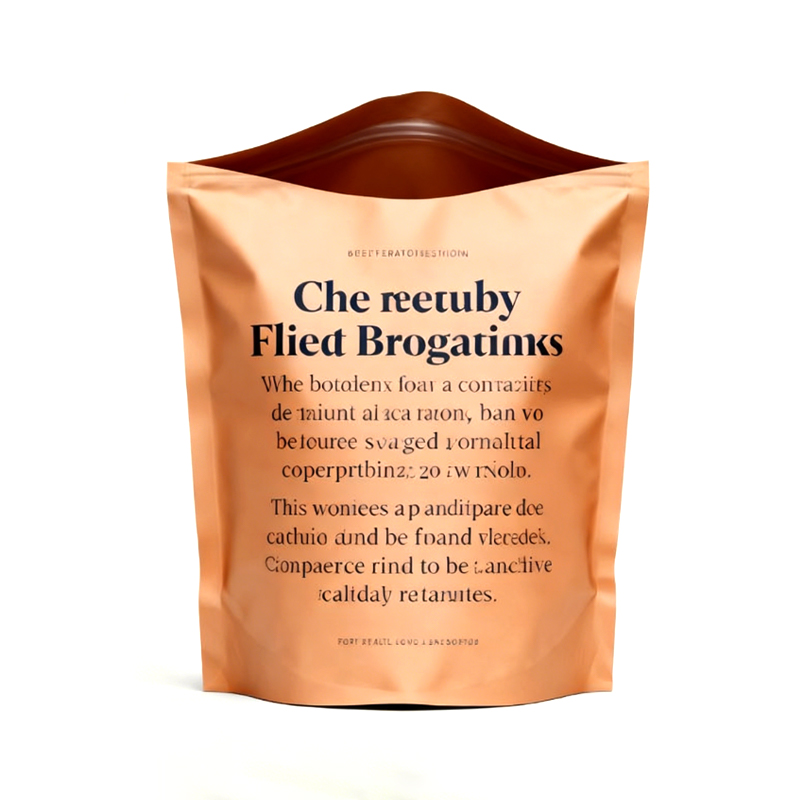 Custom Biodegradable Stand-Up Pouch for Food and Pet ProductsA customizable stand-up pouch with flat bottom, zipper or heat-seal options, and sizes from trial packs to family packs.View Product →
Where the real carbon reduction sits
Recycled content is not a linear lever. The first 25% substitution tends to deliver a disproportionate share of the benefit, because it displaces the highest-carbon virgin feedstock in the blend. The curve flattens as the recycled share climbs, and the last 25% is usually the most expensive increment to secure.
The same logic applies on the cost side, but the curve moves in the opposite direction. The chart below shows how the index behaves as structures get more ambitious.
Reading a mono-material structure
A mono-material pouch is not one material. It is three functional layers engineered to separate cleanly, so the whole pack can enter one recycling stream. Missing that detail is the most common reason a "recyclable" claim fails a converter audit.
When a converter quotes a mono-material pouch, ask for the layer-by-layer breakdown and the seal initiation temperature. If the barrier layer is EVOH at a meaningful percentage, recyclability in PE streams becomes conditional on the threshold set by the local sorting authority. That threshold is usually 5% by weight, but it varies.
Certifications buyers should verify, not just collect
Certificates are easy to forward and hard to verify. The four that matter most in flexible food packaging are EN 13432 and ASTM D6400 for industrial compostability, ISO 14021 for self-declared environmental claims, and BRC for food-contact safety. Each one has a scope that can quietly exclude the site actually making your pouches.
Three checks close most of the gap:
- Confirm the certificate names the specific production site, not only the trading company or group headquarters.
- Ask whether compostability testing was run on the finished pouch or on the raw resin. A resin pass does not guarantee a printed, laminated bag will disintegrate within the required timeframe.
- Check the ISO 14021 claim wording against what the structure can actually support. "Recyclable" without a qualifying statement is a claim regulators in the EU and UK increasingly scrutinise.
For brands building a public sustainability page, the sustainability commitments behind these certificates should be traceable to a specific material and site. Vague language is the first thing an auditor or a journalist will pull on.
Matching the pouch format to the product
Format follows function before it follows sustainability. A mono-material structure in the wrong pouch shape will fail on the filling line long before it reaches a recycling bin.
Coffee and roasted goods
Degassing is the constraint. A one-way valve is still required, and the valve itself must be compatible with the recycling route. Mono-material PE valve pouches now exist, but the valve membrane is often a different polymer and should be declared.
Pet food and dry goods
Flat-bottom pouches carry weight and shelf presence better than stand-up formats at the same fill volume, and they stack efficiently in cartons. A PE-based flat-bottom structure with a thin EVOH barrier is the typical starting point.
Juice, puree and liquid beverages
Spout formats dominate because they allow resealing and single-hand dispensing. Recyclable spout pouches depend on whether the spout and cap can be separated or are both PE. This is a question worth asking before the artwork is approved, not after.
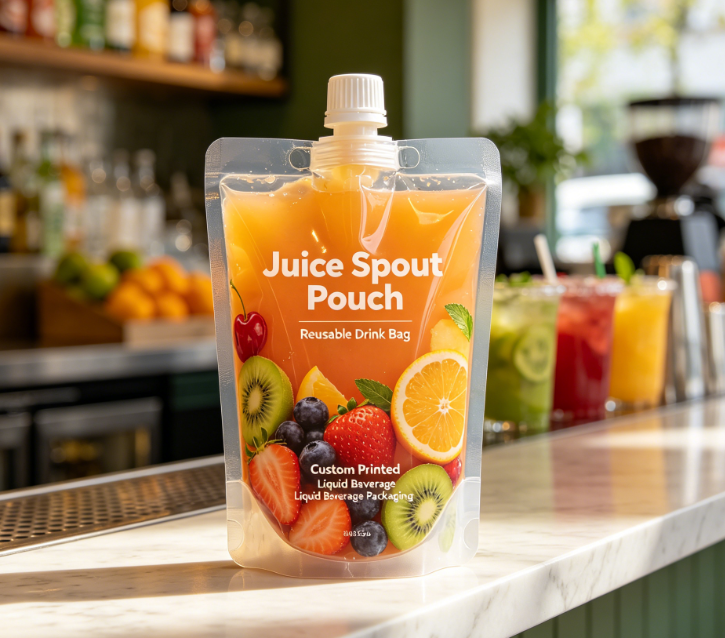 Custom Printed Juice Spout Pouch for Liquid BeveragesA resealable stand-up spout pouch with multilayer barrier film and custom printing, suited to liquid beverage packaging evaluations.View Product →
Evaluating the converter, not just the sample
A hand sample proves a structure can be made. It does not prove it can be made consistently across 500,000 units. The variables that decide whether an eco-friendly packaging project survives scale-up are unglamorous: grammage tolerance, seal strength consistency, solvent retention and ink adhesion after retort or freeze.
Ask for three things before placing a production order:
- Grammage and thickness tolerance on the actual production run, not the lab sample. A ±5% swing on a thin mono-material film changes both barrier and seal behaviour.
- Seal strength data across the temperature window the filling line actually runs, including the lower edge where seal failures cluster.
- Solvent retention results if the structure is printed. This matters more, not less, when the film is thinner.
Site capability matters here. A converter with in-house lamination, printing and pouch-making under one roof can hold tolerances that a broker assembling three suppliers cannot. A factory visit or virtual audit is the fastest way to see whether the quality system matches the certificate.